
Bellvitge and Sant Joan de Déu identify the genetic variants associated with the most severe forms of Stargardt’s disease
Research into rare diseases such as Stargardt's is only possible in leading research centres. In this case, Bellvitge and Sant Joan de Déu share the Hereditary Retinal Dystrophies Unit and cover the transition of child and adolescent patients to adulthood.
For the relatives of a child with Stargardt's disease, the question is always the same: how will the vision loss evolve? Will it progress very quickly? How much vision will we be able to keep? This rare disease causes progressive and irreversible vision loss in the central area of the retina and is linked to several mutations in the ABCA4 gene. There are several treatments in development but there is still no cure: the only measures that can be offered to patients are aimed at slowing the progression of the disease and personalising medical follow-up. One of the challenges is to predict the evolution of the disease, as there is a lot of variability between different patients and this generates a lot of uncertainty. Research is the only way to find answers.
Now, the Hereditary Retinal Dystrophies team at Bellvitge and Sant Joan de Déu has identified which variants of the ABCA4 gene are associated with the most severe forms of this rare disease. This will make it possible to better predict the evolution and severity of the disease in each patient from the moment of diagnosis. Having more information about the severity of each genetic variant would also allow better reproductive advice to carrier couples and focus future clinical trials, the researchers say. In the study, published in the international journal Investigative Ophthalmology & Visual Science, they have analysed clinical and genetic data from 245 people treated at seven reference centres throughout Spain, making it one of the largest cohorts studied so far in this disease.
Bellvitge and Sant Joan de Déu share the Hereditary Retina Dystrophies unit, which is a benchmark at the national level and monitors the disease from childhood or adolescence to adulthood thanks to the close collaboration between the professionals of the two centres.
Uncertainty, the main concern in vision loss
Stargardt's disease usually begins in childhood or adolescence with symptoms such as difficulty reading or recognizing faces, and progresses over the years with a highly variable evolution between different patients: some may worsen very quickly and lose a lot of vision, and in others the disease progresses very slowly. As it is a rare disease, it is much more difficult to study this heterogeneity and to define a prognosis and follow-up. This makes each small scientific step especially relevant to respond to patients and relatives and discover new treatments. The results of this study shed light on this uncertainty: it has been observed that the combination of two severe or null variants of the ABCA4 gene are associated with more extensive retinal involvement and more advanced stages of the disease. In addition, the duration of involvement is one of the factors that most influence progression.
"Until now, we could not guide a family with sufficient precision on whether the loss of vision would be slower or faster. This study shows that the type of genetic variant not only confirms the diagnosis, but also helps us to anticipate the evolution and personalize the follow-up," explains Dr. Estefanía Cobos, ophthalmologist at Bellvitge Hospital, co-coordinator of the Unit and researcher at IDIBELL.
Genetics as a prognostic tool
The work allows refining the classification of genetic variants and incorporating molecular information as a clinical prognostic tool, which will help to provide a better response to patients and their families. "Not all variants of the gene have the same impact. Being able to distinguish which ones are associated with more severe forms allows us to offer more precise genetic counseling and make follow-up decisions with more information," says Anna Esteve, genetic advisor at the Genetics Unit of the Bellvitge University Hospital.
This information will also be valuable in cases of reproductive advice by knowing the severity of the genetic variants of a carrier who wants to have offspring, and when selecting patients for future clinical trials with therapies that are now in development. This is how we want to move towards a precision medicine model in ophthalmology.
Reference in assistance and research
Scientific advances such as these are only possible in leading health research ecosystems with a wide territorial scope such as Bellvitge and Sant Joan de Déu. In this sense, the Bellvitge - Sant Joan de Déu Hereditary Dystrophies Unit has been in operation since 2016, is recognised as a national reference unit (CSUR) and is part of the European network of centres specialising in rare eye diseases (ERN Eye). The ophthalmology teams of the two centres work together to facilitate the transition of child and adolescent patients to adulthood and the consequent change of medical centre, in addition to carrying out research on the disease. This concentration of highly complex cases and of a wide range of ages has made it possible to bring together one of the largest cohorts analysed in the State in Stargardt's disease.
The research into hereditary retinal dystrophies of this team is part of REMMA Bellvitge, the first research program in Spain focused on rare diseases in adults. Promoted by IDIBELL within the Bellvitge Health Campus, REMMA promotes translational research with an interprofessional, multidisciplinary and precision medicine approach. Ultimately, REMMA makes it possible to accelerate diagnosis, improve follow-up, discover new treatments and strengthen territorial equity in rare adult diseases.
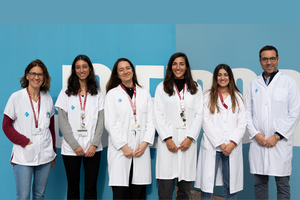
The work allows refining the classification of genetic variants and incorporating molecular information as a clinical prognostic tool, which will help to provide a better response to patients and their families.