
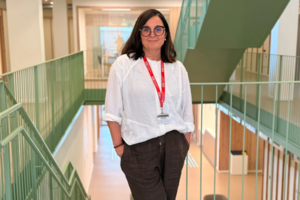
Iluminada Corripio
Director of Innovation Strategy and Promotion, Mental Health, Catalonia
"At Sant Joan de Déu professionals' ideas turn into projects"
Every year, Mental Health Week is a clear event to give visibility, reflect and act in relation to the issues facing mental health in our society. To donate visibility to the Mental Health Week that was brought to the PSSJD in interviews with Dr. Iluminada Corripio, director of Strategy and Promotion of Innovation, Mental Health, Catalonia.
Every year, Mental Health Week is a key occasion to raise awareness, reflect and act in relation to the challenges that still surround mental health in our society. To raise awareness of the Mental Health Week taking place at PSSJD, we interviewed Dr Iluminada Corripio, Director of Strategy and Innovation Promotion, Mental Health, Catalonia.
First of all, could you explain what the Somrise project consists of?
The Somrise project was born from a vision of the Parc Sanitari Sant Joan de Déu (PSSJD), led by its Director of Research, Innovation and Teaching, Dr Josep M. Haro, and the SJD-PSSJD, SJD-Esplugues and SJD Terres de Lleida managers. Although we are leaders in scientific production-we are first in terms of the number of publications in Spain, fourth in Europe and fifth internationally-we have realised that the percentage of research results that ultimately reach clinical practice is still very small. From this point onwards, at PSSJD we are committed to transforming care and therefore the future of mental health, building a real bridge between research, innovation and clinical practice. Thus, Somrise was born precisely with this objective: to articulate the existing ecosystem in order to improve knowledge transfer in the field of mental health and ensure that research results have a real impact on healthcare practice. At the same time, this is not an exclusive vision of PSSJD, but rather a commitment shared territorially by the Hospitaller Order of Saint John of God in Catalonia, led by UTI.
Among the projects that are currently part of Somrise, is there one that particularly exemplifies the philosophy you want to promote? Why?
There are different projects that were already underway and that we have helped to promote through Somrise, but I would say that the precision mental health project is, at the moment, the one that best exemplifies the Somrise philosophy. Until now, in mental health, we have often worked on a trial-and-error basis: a person with a mental health problem comes to the consultation and we are not always able to determine which treatment will work best for them. In fact, approximately 30% of these people will present a resistant condition. By contrast, in other specialties, such as oncology, we already have tests that make it possible to determine which treatment may be most appropriate for each person.
Could you highlight a specific project?
Yes, of course. At the moment, we are developing four sub-projects that will have to support precision mental health becoming a reality. The first is LaIA, which uses voice transcription to automatically collect the most relevant clinical information from interviews. This makes it possible to free professionals from part of the transcription task and, at the same time, opens the door to better incorporating the social and health information of each person. The second is NEXIA, a data architecture project that seeks to integrate different sources of information-clinical, research, digital and omic-throughout a person's life. The aim is to have quality data that will allow us to develop reliable and safe artificial intelligence tools to identify patterns of prognosis and response to treatments. Within NEXIA, we are already beginning to design the Clinical Trajectories, which will collect real-world data to better understand how the people we care for evolve, especially in highly complex conditions such as psychosis, autism spectrum disorder or treatment-resistant depression. This will allow us to identify clinical profiles and move towards increasingly personalised treatments. Finally, I would highlight the EMMA-VOICE project, which will allow us to improve the assessment of people at different points in their mental health condition (stability, crises and pre-crisis) through a chatbot; this is a recently approved European project.
What does "innovating" in mental health mean to you?
For me, innovating means putting an idea into practice while adding value. It does not necessarily have to be a technological solution; many times it means improving or introducing a new way of doing things within the existing social and healthcare system. At the moment, everything is moving very quickly and we are very distracted by the flood of information we are receiving, but we have to be able to look up and imagine the future we want for mental health together with professionals and the people receiving care. One issue that is currently at the forefront is understanding very well how we can use artificial intelligence. We cannot allow technology companies to be the ones to set the course for us. We have to design the solutions ourselves, from within our own organisations, with our professionals and with the people receiving care.
What does the Living Lab model proposed by Somrise bring compared with a conventional research study?
PSSJD was accredited as a Living Lab space in June 2025. This means that we have the ecosystem necessary to test and validate innovations in real-world settings before incorporating them into clinical practice. For example, if we develop a mobile application, we can test it with professionals and patients in a real-world setting, assess how it works and identify what needs to be improved before implementing it more broadly. This journey, from the first test to the incorporation of a solution into clinical practice, is what we understand as scalability. For this to be possible, it is essential that institutions are open to incorporating new solutions and that we are able to assess their impact. In this regard, the IRSJD Impact Unit has a key role: it must help us determine whether an innovation adds value, is sustainable and is ready to be scaled.
What makes this model different?
Research is usually carried out in highly controlled settings, with sample selection and inclusion criteria that, in some cases, may not be representative of the real population. By contrast, the living lab model seeks to develop and test solutions in real-world settings, with people who may present very diverse and complex situations: social problems, drug addictions, decompensated medical comorbidities, among others. This allows us to assess not only whether an innovation works in a testing environment, but also whether it is applicable to healthc
Mental Health Week is a key occasion to raise awareness, reflect and act in relation to the challenges that still surround mental health in our society.