
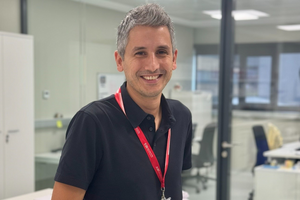
Daniel Natera
Researcher in applied research on neuromuscular diseases
"A question in the consultation room can become an answer for children around the world"
World Muscle Society 2026 Emerging Myologist of the Year Award: Daniel Natera, a postdoctoral researcher in applied research on neuromuscular diseases
What has receiving the Emerging Myologist of the Year 2026 award from the World Muscle Society meant to you?
I see it as recognition of the work carried out over the last few years by the entire team at Neuromuscular del Hospital Sant Joan de Déu and the Institut de Recerca Sant Joan de Déu. We have always been very clear that patient care and research must go hand in hand: research allows us to better understand diseases and continue improving their diagnosis and treatment. That is why receiving this award has been an enormous joy, not only on a personal level, but also for the whole team.
What do you think the international scientific community particularly valued about your career?
The committee that made the decision explained that it had particularly valued our work in the study and detailed characterisation of neuromuscular diseases. This involves analysing in depth how these diseases manifest in each patient and gaining a better understanding of the mechanisms that cause them. Over the last few years, we have developed different projects and published several scientific papers in this area, and I believe that it is precisely this track record and our team's contribution to a better understanding of neuromuscular diseases that they wanted to recognise with this award.
What does the research you carry out at the IRSJD on rare paediatric neuromuscular diseases involve?
We conduct highly translational research, that is, research closely linked to clinical practice and patients' needs. Many of the scientific questions we ask arise directly from our work in the consultation room: from observing patients, studying their clinical characteristics and analysing their genetic results. All this information leads us to formulate new questions in order to better understand each disease.
Why is it so difficult to diagnose some of these diseases?
The difficulty in diagnosing some patients is mainly due to three major factors. Firstly, there are still genes associated with neuromuscular diseases that we do not know about or that may go undetected with current diagnostic tools. Secondly, despite the significant advances in genetic diagnostic techniques, there are certain types of alterations or variants that we are still unable to identify. And finally, even when we manage to detect a genetic variant, we cannot always determine with certainty whether it is responsible for the disease. In other words, identifying an alteration in a gene does not necessarily mean knowing what its impact is. For this reason, diagnosing some diseases remains a complex process, and research is essential to continue improving our ability to identify and interpret the genetic causes of these conditions.
What is your research currently focusing on?
At present, we are very focused on improving the diagnosis of patients with rare neuromuscular diseases. One of our main lines of work is to study and better interpret genetic variants that, in some cases, we do not know whether they are related to the disease or are simply changes with no consequences. To find out, we carry out functional studies in the laboratory that allow us to analyse how these variants affect the functioning of cells and proteins. We also work on identifying new genes that may explain the disease in patients who still do not have a diagnosis. This search for new genes is a very important part of our research, as it allows us to advance our understanding of neuromuscular diseases and provide answers to patients and families who have been searching for an explanation for their disease for a long time.
What role do biomarkers play in your research?
Another very important line of our research is the search for biomarkers. This involves identifying indicators that allow us to understand how a patient's disease progresses over time and assess whether a treatment is effective. In the field of neuromuscular diseases, we still have few biomarkers available, which makes it particularly important to make progress in this area. Our group also works on developing digital biomarkers that allow us to measure aspects such as patients' mobility and observe how it changes over time. The aim is to have tools that help us detect possible improvements or changes in the progression of the disease following treatment. In this way, we will be able to better assess each patient's response and move towards increasingly personalised care.
Could you give us an example?
Yes. We recently published the study A Recurrent 3′UTR Variant in CAPN3 Highlights the Diagnostic Impact of Non-Coding Variants in Limb-Girdle Muscular Dystrophies on several patients with a form of muscular dystrophy called calpainopathy. In these cases, we suspected that the patients had this disease, but we were unable to identify with certainty the genetic alteration responsible. We found a variant in a gene that was initially considered to be of uncertain significance, meaning that we did not know whether it was actually the cause of the disease. However, after carrying out different genetic and functional studies in the laboratory, we were able to demonstrate that this variant was indeed pathogenic and that, therefore, it was responsible for these patients' muscular dystrophy.
What would you highlight about this study?
The most significant aspect is that this work, carried out in collaboration with other international groups, not only made it possible to provide an answer for one of our patients, but also for more than ten patients from different countries who were in the same situation. It is a good example of how research can help solve cases that initially remain without a definitive genetic diagnosis and, at the same time, benefit patients around the world.
What is the major outstanding challenge in diagnosing rare neuromuscular diseases?
The major challenge, or I would say the major challenges in neuromuscular diseases today, would be threefold: being able to diagnose more patients, ensuring that all patients receive their genetic diagnosis, having better biomarkers for neuromuscular diseases and, ultimately, and perhaps most importantly, developing effective treatments for more diseases. We are beginning to see gene therapy treatments for some diseases, such as spinal muscular atrophy, for example, but unfortunately many diseases still have no treatment.
To conclude the interview, what motivates you every day to work as a researcher?
I am a doctor and, precisely, what motivates me most as a researcher is the curiosity that arises in the consultation room. When you are in front of a family and questions come up for which we still do not have an answer, the need to try to find one emerges. The most rewarding thing is that many of these questions arise from patients we care for in our day-to-day work, but the answers we find through research can end up helping many more people anywhere in the world. This possibility of turning an unanswered question into knowledge that can improve the lives of other patients is undoubtedly what motivates me to keep researching every day.
One of our main lines of work is to study and better interpret genetic variants that, in some cases, we do not know whether they are related to the disease or are simply changes with no consequences.