
Irene Cuervas
Researcher at Sarcomas and Neuroblastoma research group
The prestigious Odile Schweisguth Award recognizes Irene Cuervas' research to open new avenues against Ewing's sarcoma
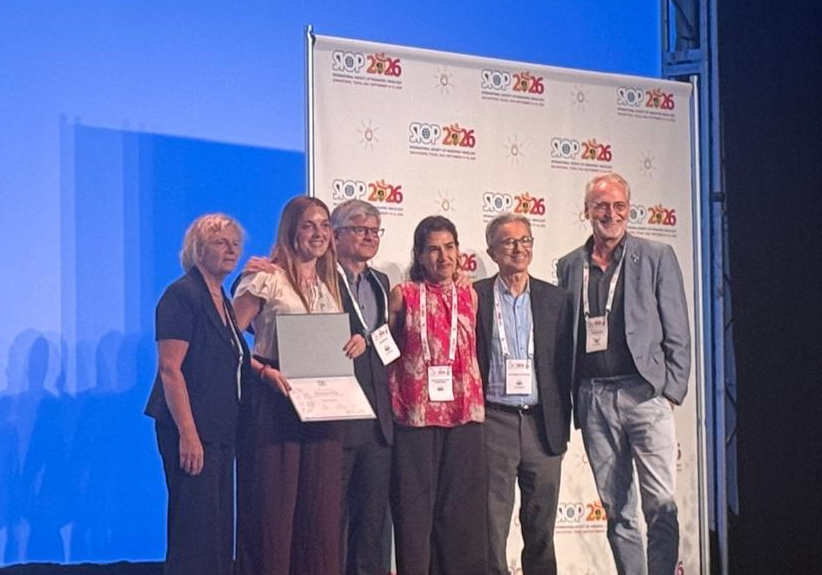
The research on Ewing's sarcoma by Irene Cuervas, postdoctoral researcher in the Sarcomas and Neuroblastoma research group of the Sant Joan de Déu Research Institute (IRSJD), has been recognized with the Odile Schweisguth Award, one of the most prestigious international awards for researchers in training.
Research into Ewing sarcoma by Irene Cuervas, a postdoctoral researcher in the Sarcomes i Neuroblastoma research group at the Institut de Recerca Sant Joan de Déu (IRSJD), has been recognised with the Odile Schweisguth Award, one of the most prestigious international awards for researchers in training in the field of paediatric oncology. This recognition consolidates a track record of excellence in this field at Sant Joan de Déu, which has received this award for the third time in just nine years. Previously, Guillem Pascual, PhD, was recognised in 2018 for his research into retinoblastoma, and Estela Prada, PhD, in 2024 for her research into rhabdomyosarcoma.
We spoke with Irene Cuervas to learn more about the research that earned her this prestigious international recognition and to understand what impact it may have on patients in the future.
Irene, could you explain what the research recognised with the prestigious Odile Schweisguth Award focuses on?
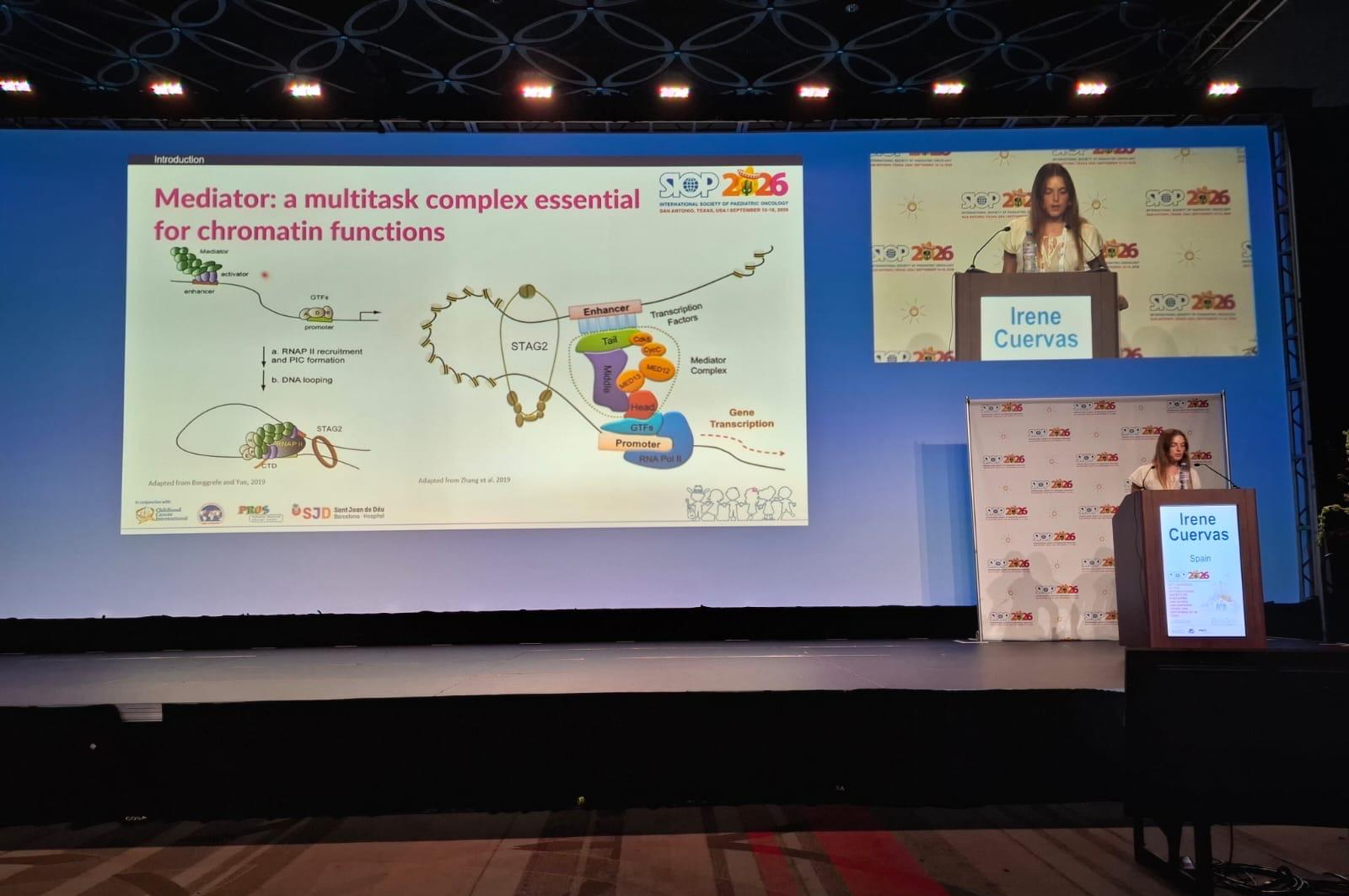
My research focuses on Ewing sarcoma, a type of tumour characterised mainly by a specific genetic alteration: the EWS::FLI1 fusion. This alteration regulates the activity of different proteins, and we have studied two of them in particular that are involved in the process of splicing, the mechanism that determines how genetic information is edited and expressed to generate proteins.
And what did you observe?
What we observed is that these proteins promote the tumour's expression of certain variants that contribute to its growth. From there, we explored whether we could intervene in this process using splicing inhibitor drugs. One of the compounds studied, indisulam, showed very promising results: in laboratory models, both in vitro and in vivo, we saw that it was capable of stopping tumour growth and even making the tumour disappear in some cases. So, it has very good prospects, really.
What do you think the Award jury particularly valued?
I think the jury valued above all the fact that we obtained such promising results in in vivo models, which reinforce the translational potential of the research. Demonstrating that the drug works beyond the initial laboratory studies and that it could have potential for future clinical application, I believe, was key.
And now, what next? How will the process move forward from here?
The next step is now to delve deeper into the preclinical phase of the research. We want to expand the validation of the treatment by incorporating more PDX (patient-derived xenografts) models developed at the Hospital Sant Joan de Déu, created from tumour samples altruistically donated by patients' families. In fact, without this generosity, advances like this would not be possible. These models allow us to reproduce tumour behaviour more faithfully and obtain more evidence about the efficacy of the drug. From there, the goal would be to move towards a clinical trial. In fact, this same drug has already been evaluated in previous clinical studies involving adults, and it was observed that it is not toxic, which may facilitate the future stages of developing therapy with this drug.
What are you focusing on these months?
My main objective, from now until the summer, is to publish the paper. I am completely focused on that.
Irene, had you always wanted to become a researcher?
Yes and no. I remember that when I was in secondary school, they told us the story of Dolly the sheep and it had a great impact on me; it was probably the first time I thought that research could really change things. However, when I finished my degree in Biotechnology, I was not sure that I would go into research. In fact, I started by doing an internship in quality control, a very different environment from what I do now. My Final Degree Project (TFG) was also research-oriented, but in a completely different field: water purification. Later, I completed a Master's degree in Immunology, and that was when I started doing an internship in a biomedical research laboratory and became certain that this was the path I wanted to follow. I arrived at Sant Joan de Déu in September 2019 thanks to the support of the donations received by the Hospital. Later, in 2024, I was able to continue developing this line of research thanks to the FA-VI-AL grant, in memory and tribute to the young Fabricio, Víctor and Alex, promoted by the Policias x Valientes (PxV) initiative of the Policia Municipal de Terrassa.
What do you feel when you see such generous gestures supporting research?
Research is a long-distance race. We move forward by adding small grains of sand that, over time, can end up transforming patients' lives. As a researcher, you would like the results to arrive immediately, but behind every advance there are years of work, resources and many people involved. Therefore, when you receive support through initiatives as generous as this one, the feeling is one of enormous gratitude: because they make it possible for science to continue moving forward. What I find truly admirable is that families who lose a son or daughter, instead of becoming angry, transform this pain into the creation of initiatives that promote research to combat the disease.
Do you think that one day we will cure Ewing sarcoma?
At this point, it is difficult for me to specify a date, but research advances day by day and I am convinced that we will continue taking steps towards achieving this. In the short term, I believe we will be able to make progress in stratifying patients in order to offer treatments that are increasingly tailored to their individual characteristics. This will allow us, at least, to reduce the use of treatments that ultimately prove ineffective because of the particular characteristics of each patient's tumour.
Would you like to take this opportunity to thank anyone in particular?
Yes, if you allow me, I would like to end this interview by especially thanking the support of my mentors, Dr. Jaume Mora, head of the Sarcomas and Neuroblastoma group at the IRSJD, and Dr Inmaculada Hernández-Muñoz, researcher in the Grup de Recerca en Recerca en Malalties Inflamatòries i Neoplàstiques Dermatològiques de l'HMRIB. They are the people who, from the beginning, devised this project and supported my research throughout the entire process.
Finally, what do you think differentiates research at Sant Joan de Déu from that of other research centres?
In fact, I think that if there is something that differentiates Sant Joan de Déu, it is its commitment to deeply translational research. Ultimately, the objective is not only to generate knowledge or publish scientific results, but to ensure that this knowledge has a real impact on patients' lives. Dr Mora conveys this way of understanding research very well: always keeping the focus on finding new opportunities to improve the care of children and adolescents. Here, in the building of the Pediatric Cancer Center Barcelona (PCCB), from the moment we arrive first thing in the morning, we connect with the purpose of our work. In the same space, patients, families, researchers, healthcare professionals and management teams work alongside one another. This proximity means that we never lose sight of who we conduct research for or the ultimate meaning of everything we do.
Thank you, Irene, for the research you are driving forward and for dedicating part of your time to this interview.
This milestone reinforces the role of Sant Joan de Déu as an environment capable of attracting, training and promoting high-level research talent and consolidates its position as an international reference hub for paediatric oncology research.